Series: Openalice (4/6)
Trading-as-Git: OpenAlice's Design Philosophy for Version-Controlling Trading Decisions
If you've used Git, you've probably had this experience —
Before a commit, you run git diff and take a look at what you actually changed. That one action is often what makes you realize "I thought I was changing A, but I actually changed B, C, and D."
OpenAlice took that mechanism and applied it to trading.
Why Trading Needs "Version Control"
Anyone who trades has had that moment: you place an impulsive order, then half an hour later wonder "what was I thinking?"
This isn't an emotional management problem — it's a problem of a decision process with no record-keeping mechanism.
Traditional trading interfaces are designed to be fast — see a signal, click a few times, place the order, done. The faster the better. That's genuinely necessary for certain strategies, but for most people, having the decision process leave a record matters more than shaving ten seconds off execution time.
The logic of Trading-as-Git: force one extra "confirm what you're doing" step before execution.
How Trading-as-Git Works
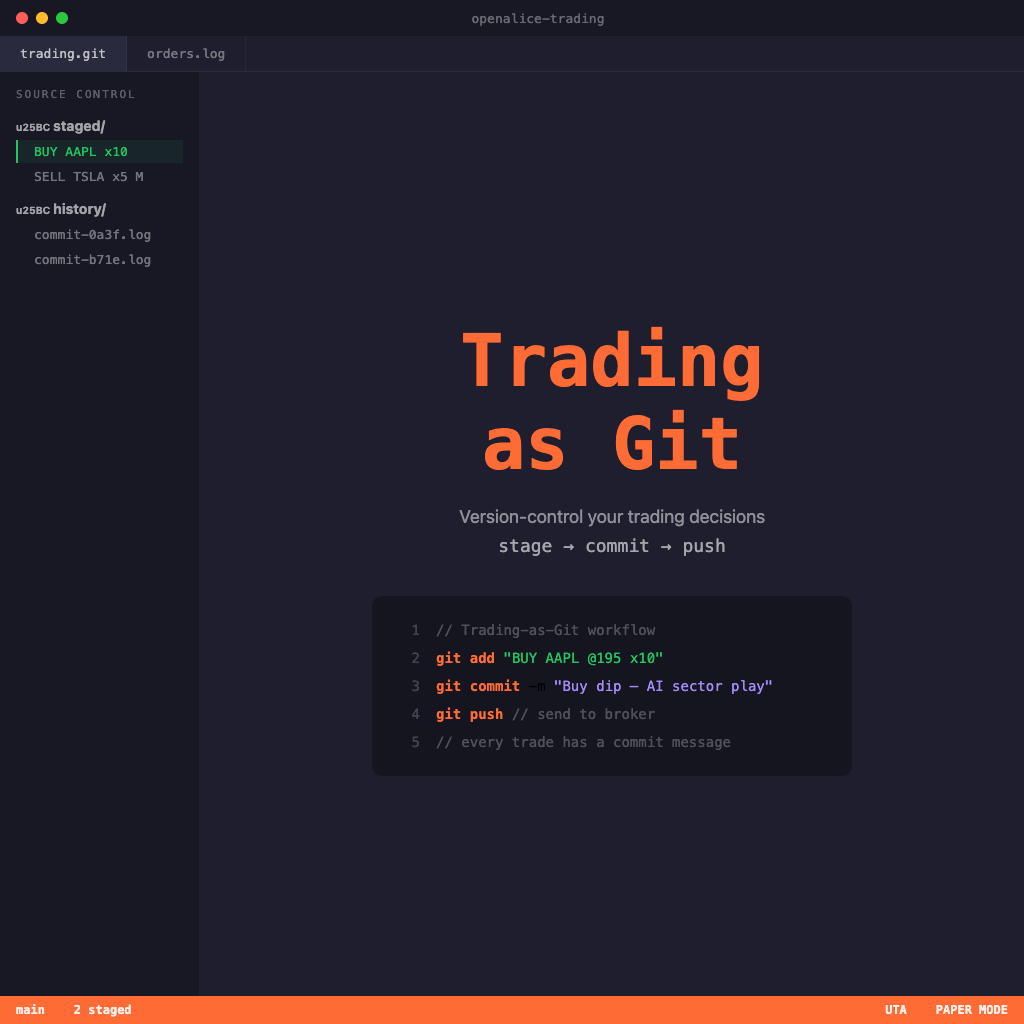
OpenAlice maps the trading process to three Git concepts:
Stage (Queue the Order)
You want to buy 100 shares of AAPL — first you stage that order. It enters the staging area, but it hasn't executed yet. At this point you can add, modify, or remove orders.
This staging area lets you consider the combined effect of multiple orders at once, rather than clicking through them one at a time. Imagine you want to put on a long NVDA / short INTC pair trade — in a traditional interface you'd need two separate operations. In OpenAlice's staging area, you put both in first, confirm the ratio is right and the risk fits your expectations, then execute them together.
Commit (Decision Record with a Message)
The commit action requires you to attach a message.
This isn't ceremony — it forces you to articulate why you're doing this:
commit: long NVDA 100 shares
message: "Q2 earnings beat, data center guidance raised 15%,
          entering position ahead of institutional rebalancing"
That message gets recorded in your trade history. A month later, you can look back: what was your entry thesis, what was the outcome, which judgments were right.
This is what people call a "trade journal" — except OpenAlice makes it happen automatically, rather than requiring you to open Notion and write it by hand.
Push (Actually Execute)
Completing a commit doesn't mean the order is sent to the broker. You still need to Push for the order to actually be submitted for execution.
This extra step might seem unnecessary — but it exists to give you one final "am I sure?" moment, especially in automated workflows: even if the AI staged and committed an order for you, you still have the option not to push, keeping execution at the human review stage.
The Audit Trail: The Real Value of Trade History
Another benefit of Trading-as-Git is a complete, queryable record.
Every commit has a hash, and you can use that hash to trace back the decision record for any trade: what the market conditions were at the time, what reasoning you gave, exactly when you pushed.
This is enormously valuable for learning your own trading patterns — not relying on a feeling of "I think I've been doing well lately," but using records to show you which entry logic actually works and which was just luck.
This pairs with OpenAlice's Account Snapshots feature: the system periodically or event-driven captures account state and generates equity curve visualizations. Your trade history and account state changes can be viewed together.
Paired with AI: The Power of Semi-Automation
Trading-as-Git combined with AI creates an interesting division of labor:
AI does the research and recommendations → analyzes the market, finds signals, suggests entry and exit points
AI helps you stage & commit → translates research conclusions into concrete orders, with decision rationale auto-attached
Human decides to push → the final execution step stays in your hands
This model means you don't have to monitor the market start to finish, but there's still a human confirmation step before execution. Based on your confidence level and strategy, you can decide which parts of the workflow go fully automatic and which stay manual — that's what the Guard Pipeline is for, which is covered in the next article.
Common Questions
Q: Can I let the AI fully automate stage, commit, and push?
Yes — through a combination of automated schedules and the Guard Pipeline, you can configure the AI to run the complete workflow end-to-end under specific conditions. But OpenAlice's design encourages running in human-in-the-loop mode first for a while, building trust in the AI's judgment before gradually relaxing control.
Q: Do I write the commit message or does the AI?
Usually the AI auto-generates it based on its analysis. You can accept it or modify it. This is one of the genuinely useful things AI does for you: automatically records its reasoning process as your trade journal.
Q: How is this different from a traditional stop-loss order?
A stop-loss is passive protection after the fact; Trading-as-Git + Guard Pipeline is active boundary-setting beforehand. They can be used together — they serve different purposes.
The Essence of This Design
Trading-as-Git isn't a gimmick about "managing stocks the way you manage code" — it's taking a cognitive tool that has already been proven effective (code review before merge) and applying it somewhere that desperately lacks it (trade execution).
Force records to be kept. Force the reasoning to be stated clearly. Force one extra confirmation step. Do those three things, and trade quality tends to go up — not because you got smarter, but because your decision process now has structure.
Build that structure first. Then talk about automation.
Back to the Series Overview
This is the third stop in the OpenAlice series, covering the Trading-as-Git design philosophy. The next article is Research and Analysis Module: Cross-Asset Market Data and Fundamentals in One Place, which introduces OpenAlice's market research tools. The full reading map is at OpenAlice Beginner's Course.