Series: Hermesagent (2/6)
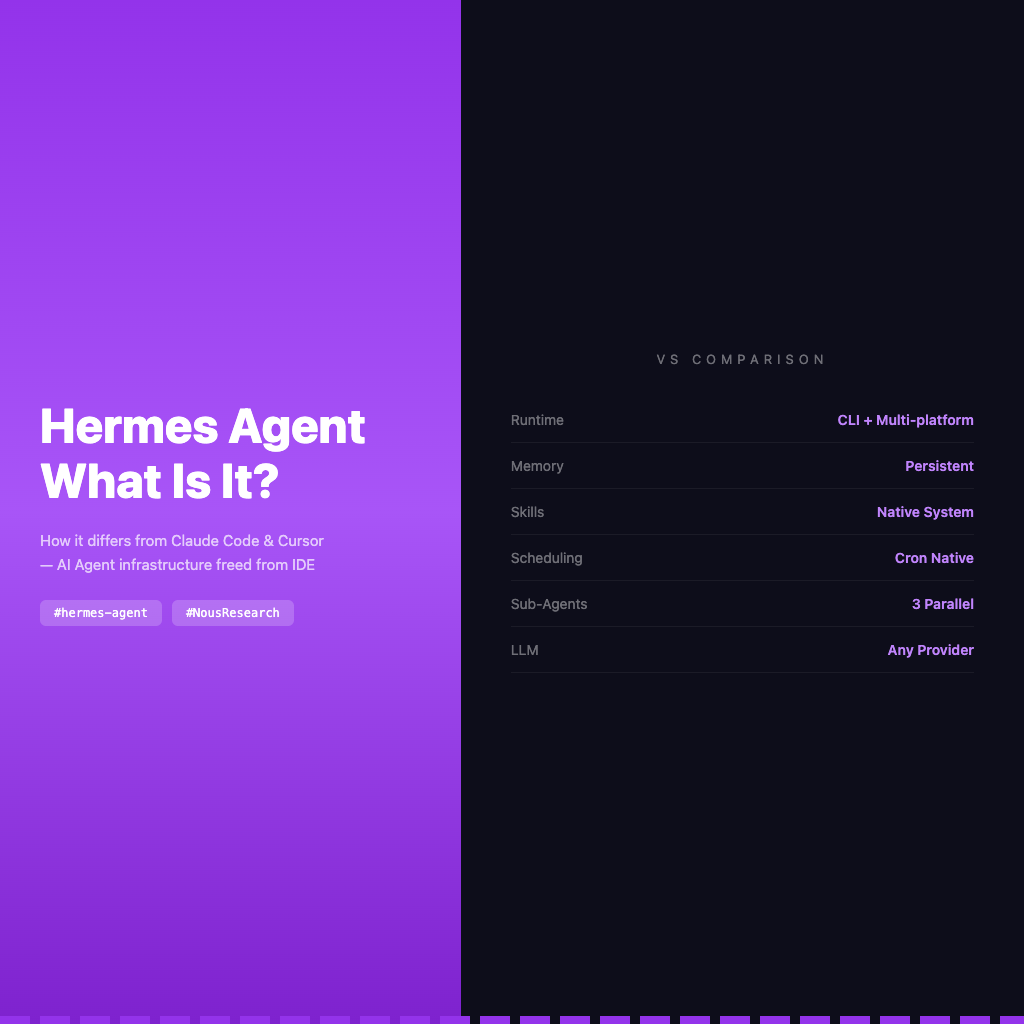
What Is Hermes Agent? How It Differs from Claude Code and Cursor
A lot of tools call themselves "AI Agents" — some mean an LLM that helps you write code, some mean a chat window with tool access, some mean an automated pipeline running on CI. These definitions have nothing to do with each other, yet they all carry the same label.
Hermes Agent's definition is closer to: an AI Agent runtime environment running on your machine, with tools, memory, Skills, multi-platform support, and scheduling — and critically, all of these are integrated together, not scattered across three different plugins.
This article's job: help you build the foundational worldview, so you understand what problem Hermes is solving, what its architecture looks like, and how it differs from tools you may already be using.
Which Layer Does Your Current Tool Solve?
Let's be clear about a few names up front to avoid confusion later.
Claude Code / Cursor / Windsurf solve the problem of "having AI help you write code inside an IDE." Their core scenario: you're in a codebase, AI reads your files, modifies your code, helps you run tests. They're very capable, but fundamentally IDE-bound — leave that window, and the agent is gone.
Superpowers / Gstack / GSD solve "how to make this AI Agent follow the right process and ask the right questions" — they're skill and workflow packages that run on top of Claude Code, not standalone Agent environments.
Hermes Agent solves a different layer of the problem: where should an AI Agent live, how should it persist long-term, and how should it maintain consistency across different platforms and tasks.
Run in CLI, or in Telegram, Discord, API Server. Memory persists across sessions. Skills are independent knowledge documents — installable, shareable, upgradeable. Tasks can be scheduled to run automatically at 3am. Sub-agents can execute in parallel.
This isn't "a better chat window." It's a more foundational infrastructure layer.
Hermes Agent's Core Architecture
You can think of Hermes as three stacked layers:
Layer 1: Tools & Toolsets
This is what the agent can do — search the web, execute terminal commands, operate a browser, read/write files, generate images, send messages. Each tool is a function, packaged into a toolset, togglable by platform or scenario.
Running hermes tools shows you what's available, what's enabled, and how to configure it. You can specify "this session only uses web and terminal, no browser" — saving tokens and making behavior more predictable.
Layer 2: Memory System
Two files, MEMORY.md and USER.md, stored in ~/.hermes/memories/, injected into the system prompt at the start of every session.
MEMORY.md is the agent's personal notes: "This machine runs Ubuntu 22.04, Docker is installed, SSH port is 2222 not 22."
USER.md is your user profile: "This user prefers concise answers, dislikes over-explanation, primarily works in TypeScript."
The point: you don't have to re-explain everything every time. The agent remembers.
Layer 3: Skills System
This is Hermes's most distinctive design — there's an entire article dedicated to it. The short version: Skills are Markdown documents that tell the agent "in this kind of situation, follow this workflow." Each skill automatically becomes a slash command.
/plan design a rollout plan for auth migration
/arxiv find papers on diffusion models from last month
/k8s deploy my service to the cluster
Skills aren't prompts, aren't plugins — they're installable, shareable, agent-creatable procedural memory.
The Real Difference From Claude Code
This is the most frequently asked question. Here's a direct comparison:
| Dimension | Claude Code / Cursor | Hermes Agent |
|---|---|---|
| Runtime | Inside an IDE window | CLI + multi-platform (Telegram, Discord, API) |
| Memory | No cross-session memory | Persistent MEMORY.md + USER.md |
| Skills | Relies on external skill packages (like Superpowers) | Native Skills system, self-buildable and installable |
| Scheduling | None | Native Cron scheduling |
| Sub-agents | No native parallelism | Up to 3 parallel sub-agents |
| LLM support | Usually bound to specific models | Supports any provider, configurable fallback |
| Deployment | Development machine | Dev machine, server, Telegram bot |
Where Hermes loses to Claude Code: IDE integration depth. If your primary work is writing code inside a codebase, Claude Code's integration with codebases is still tighter — diff previews, file context, inline editing are smoother experiences.
Where Hermes wins: when what you want the AI Agent to do goes beyond "write code in this codebase" — you want it to automatically compile yesterday's news every morning, respond to your commands on Telegram, run a batch data processing job at 3am, and still remember that you said "don't run Docker with sudo" last week.
How Fast Is Installation?
pip install hermes-agent
hermes chat
Two lines. Then ask it what tools and skills it has, and it'll tell you.
To add Telegram:
hermes platform add telegram
# Follow the prompts to enter your bot token
To switch LLM providers:
hermes model
# Interactive menu: choose Anthropic / OpenAI / Google / Ollama / any OpenAI-compatible API
The entire configuration lives in ~/.hermes/config.yaml, in Markdown format, directly editable.
One-Line Positioning
Hermes Agent isn't "a better Cursor," and it isn't "a more powerful chatbot" — it's the infrastructure that frees AI Agents from IDE windows, letting you deploy AI capabilities to more places, maintain memory across sessions, and determine behavior through Skills rather than re-briefing the agent every time.
If your current workflow is 100% writing code inside an IDE, Hermes might not be the most urgent investment.
But if you're starting to feel "every AI conversation requires re-explaining the background," "I want this task to run automatically at 3am," "I want to reach the same AI from Telegram" — Hermes is what solves those problems.
Next article: The Skills System — Getting AI Agents to Ask the Right Questions at the Right Time.