Series: Gsd (6/7)
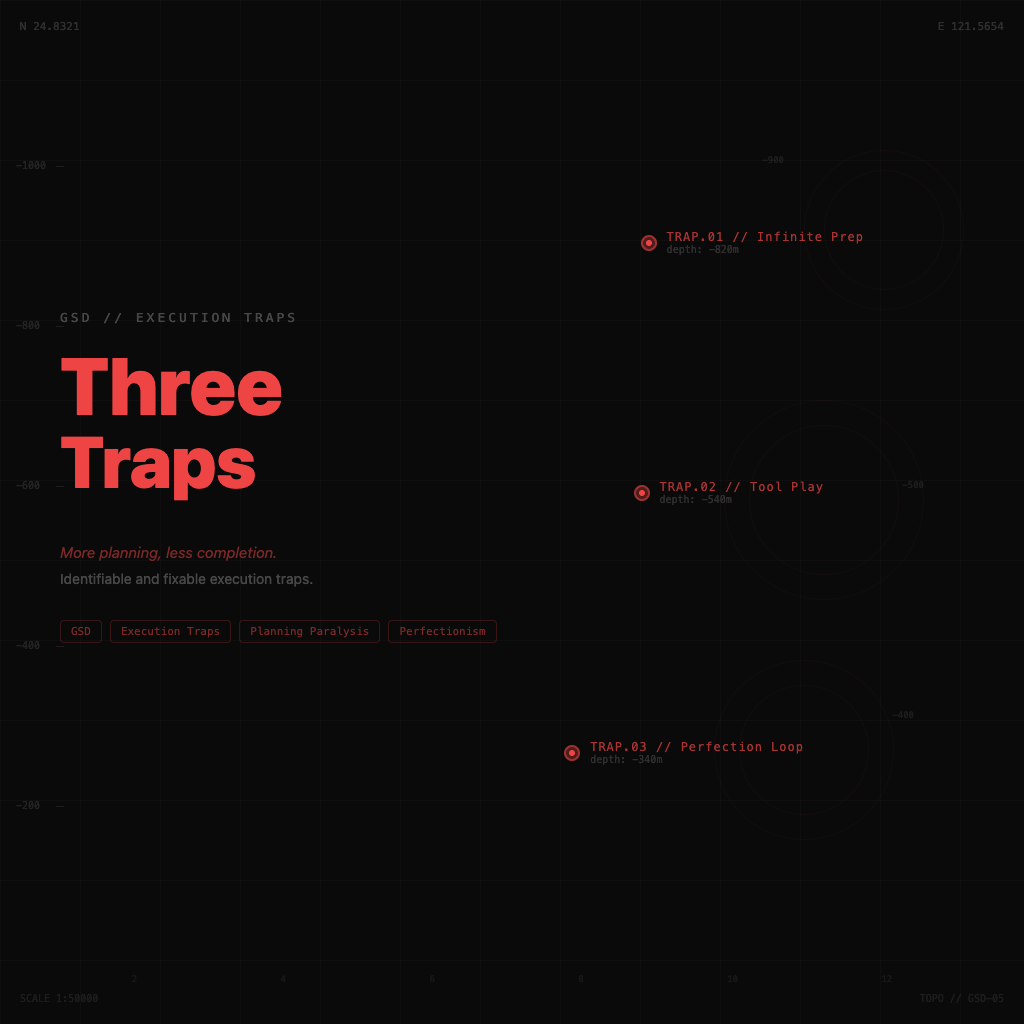
The 3 GSD Traps: Why More Planning Leads to Less Completion
There are ways of staying busy that, when you open your task list at the end, show nothing moved.
Not because you were slacking — quite the opposite. You were serious all day: opened lots of conversations, wrote lots of notes, researched lots of things. But when you take stock before bed, not one thing is "fully done, checkable, shippable."
These are execution traps. Their common feature: every individual thing you did had a reasonable justification, but together they added up to zero progress.
Trap 1: Infinite Prep
Some tasks are always "not ready to start."
You want to write a technical article, but you haven't finished surveying the competition. You want to build a feature, but you're still reading relevant documentation. You want to launch a product, but you're still doing market research.
Prep itself isn't the problem — the problem is when prep has no endpoint.
AI makes this trap worse, for a simple reason: research with AI is nearly free. Before, finding one piece of information took half an hour. Now you can read summaries of ten pieces in five minutes — and your brain decides "still not enough," and keeps demanding more. This is your brain saying "I don't feel safe yet, keep prepping" — not a genuine need for more information.
How to recognize if you've fallen into this trap:
Ask yourself: "Do I already know enough to build a first testable version?"
If the answer is "pretty much, but a little more would be better" — you're probably already in the trap. That feeling of "a little more would be better" never goes away until you decide it's enough.
How to get out:
Set a "prep time limit": before starting any task, decide the maximum time you'll spend on prep. When time's up, start with what you have. The gaps will surface during execution — that's where real research needs happen.
Trap 2: Tool Tinkering
There's a form of busy-ness that involves organizing your work environment, not doing the work.
Reorganizing Notion into a perfect database structure. Tweaking the AI system prompt to its most perfect version. Redesigning the task management system. Reformatting the to-do list.
All of these have value, but none of them is doing what you're supposed to be doing — they're building a fortress of "I feel like the work environment has to be ready before I can work."
AI tools made this trap more sophisticated. You can spend an entire day optimizing how you use AI, exploring new tools, trying new prompt techniques — every hour feels productive, but not one deliverable you actually need to ship got pushed forward.
The more hidden variant: using AI to generate a very comprehensive plan, then spending time formatting that plan beautifully, then sharing the plan with others — but the first step in the plan was never executed.
How to recognize if you've fallen into this trap:
Ask yourself: "Did anything I did today directly advance any deliverable?"
Not "the environment for making it better" — the deliverable itself. An article, a feature, a proposal, a test.
How to get out:
Do one real thing first, then organize the environment. Make "use first, optimize later" a rule. Tools good enough is good enough — they don't need to be perfect.
Trap 3: Conversation Drain
This is the newest trap, born in the AI era.
You had a long conversation with AI — discussed architecture, discussed strategy, discussed methodology — every exchange had depth, and you felt "this problem is clearer in my mind now." Then you closed the window, and the progress on that problem is: zero.
Conversation gives a very convincing sense of "work feeling" — you had input, output, back-and-forth, conclusions. But the output of conversation is "thoughts," not "outcomes." Thoughts don't directly equal progress unless you turn them into action.
This trap has a very typical signal: your AI conversation history is long and rich, but your git log, your publish history, your completed checklist is sparse.
A counterintuitive suggestion for AI use: don't let conversations get too long.
Long conversations have two problems: first, AI gradually loses focus in very long contexts, and response quality degrades; second, your brain mistakes "we discussed a lot" for "I did a lot."
How to get out:
Set an "action ending" for each AI conversation — when the conversation closes, you must extract at least one specific action you can execute today, and immediately add it to today's task list. The conversation itself doesn't count as completion — that action being done is what counts.
The Common Root of All Three Traps
Infinite prep, tool tinkering, conversation drain — they look different, but the underlying mechanism is the same:
You're using "looks like hard work" things to avoid the risk of "actually pushing forward."
Prep lets you delay the moment when "something not-good-enough gets seen."
Tool tinkering lets you delay the moment when "starting work in an imperfect environment."
Conversation drain lets you delay the moment when "turning ideas into something testable."
This isn't laziness — this is your brain consuming your work time in the lowest-risk way available. Recognize it, then say no to it — that's the core half of the GSD mindset.
A Quick Daily Self-Check
At the end of each day, ask yourself these three questions:
- Did anything get completed today (something I can check off, something I can push out, something someone can use)?
- Among what I did today, was anything "felt like effort but didn't advance any deliverable"?
- If I could only do one thing tomorrow, what would it be?
These three questions, made into a habit, give you a very simple loop calibration tool.
Next Step
With the traps identified, the final article maps the entire GSD system to real work scenarios: code, writing, proposals — the three most common task types, each with its own launch rhythm, common sticking points, and how to run through them with GSD routines.
See Real-World GSD: Practical Playbooks for Code, Writing, and Proposals.
Back to Series Overview
This is the fifth stop in the GSD series, covering identifying and fixing the three execution traps. For the full reading path and other article topics, return to the GSD Beginner Course.