Series: Gsd (2/7)
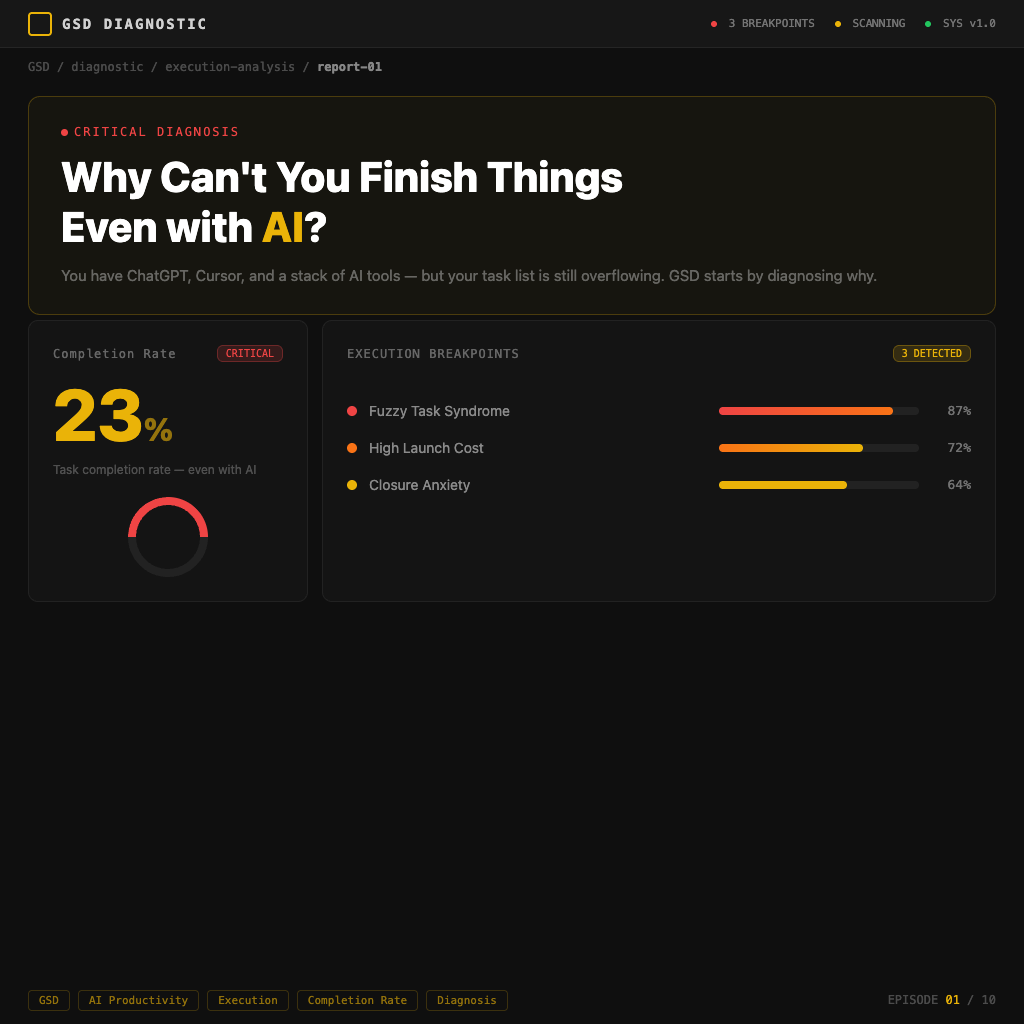
Why Can't You Finish Things Even with AI? A GSD Problem Diagnosis
You open Notion — the plan is beautifully organized. You pull up ChatGPT — a well-structured document in three minutes. You write some code in Cursor — today feels productive.
Then you close your laptop, do a quick accounting, and realize that thing you said was "almost done" two weeks ago is still sitting right there.
This isn't you not trying hard enough, and it's not the AI being dumb enough. The problem is a few very specific execution breakpoints — most people don't know what to call them, so they just explain it as "I've been off lately."
From "Looks Busy" to "Nothing Got Done"
There's a very common working pattern that looks like this: you open AI tools a dozen times a day, every conversation is productive, notes accumulate, understanding deepens — but when the moment comes to actually deliver something, you find nothing is ready.
You used AI to research a ton of information, but haven't distilled it into conclusions.
You used AI to draft several versions, but haven't decided which one to send.
You used AI to generate a plan, but haven't started step one.
This state has an unflattering name: productive procrastination — using things that look productive to avoid the step that's actually a little hard or a little risky.
AI tools accelerate this pattern. You can research faster, draft faster, plan faster — which means you can also procrastinate faster.
The Three Most Common Execution Breakpoints
1. The Fuzzy Task Syndrome
"I need to do X." That sentence is an intention, not a task.
Intentions can't be executed — only actions can. "Do X" and "open this file, revise the third paragraph, add these two data points, save" are completely different things.
The problem is: 97% of most people's to-do lists are intentions, not actions. AI helps you generate more content, but that content is still sitting at the intention level — you still have to translate it into "the next step I can take right now" yourself.
Skip that step, and you'll stare at the list, then drift toward something clearer to work on.
2. High Launch Cost
Some tasks aren't undone because you don't want to do them — it's that every time you try to start, you have to do a bunch of preparation first: find the folder, remember where you left off, check whether requirements have changed, figure out the order — and five minutes have passed and you're still "getting ready to start."
AI makes this problem worse, not better. Every AI conversation is a brand new context. No memory, no continuity — every time you start, you have to re-establish the background. Launch cost becomes a high wall, and sometimes you'd rather open a new chat to discuss something easy than face the task that requires rebuilding context.
3. Completion Anxiety
"This isn't quite good enough yet, let me fix it a bit more."
That sentence has killed a lot of things that could have been done. Its underlying logic is: once it's submitted, it gets judged. Keep revising, and you stay in the safety zone.
AI makes this problem worse, for a counterintuitive reason: AI makes "revise one more version" nearly free. Before, revising a version took half an hour — maybe two or three revisions and you'd commit. Now a revision takes three minutes, so you can do ten, twenty — and then you realize you're not converging at all, just looping infinitely.
Why AI Tools Don't Automatically Solve These Problems
The common thread of these three breakpoints is: they're all your own execution decisions — AI can't make them for you. It can only run after you've made the call.
"What's the next step right now?" — you can't hand that question to the AI.
"Where do I start with this task?" — you need the answer first, then AI knows where to help.
"Good enough, time to ship." — that judgment can only be yours.
AI is a powerful execution tool, but it's not a tool that can decide "should I start moving yet." GSD is about repairing exactly that decision layer.
Which Problem Is Yours?
Use this quick self-diagnosis to find where you're stuck:
- Often stare at the list not knowing where to start → Fuzzy task problem is most severe; read Article 3 first (task breakdown)
- Good at planning, always in the state of "getting ready to start" → High launch cost; read Article 4 first (execution loop)
- Did many versions but never want to submit → Completion anxiety; read Article 2 first (Done > Perfect mindset)
- Seems like all three apply → Read from the beginning in order; Article 2 is the root, the others are branches
Next Step
Now that the problem is clear, what do you do about it?
The root cure starts with a mindset shift — before any tool or technique enters the picture, you have to accept that "an imperfect completed thing is more useful than a perfect plan that never got done."
That's the subject of the next article: Done > Perfect: The Core GSD Mindset, from Planning Paralysis to Actually Moving.
Back to Series Overview
This is the first stop in the GSD series, diagnosing the root causes of "still can't finish things even with AI." For the full reading path and other article topics, return to the GSD Beginner Course.